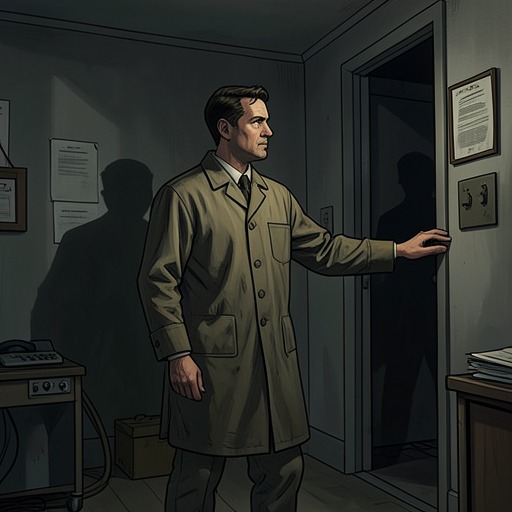
Molina’s status as a prison informant
Kiss of the Spider WomanMolina’s status as a prison informant turns his growing closeness to Valentin into a covert instrument of the prison authorities, but the arrangement never makes him simply their agent. The Warden solicits reports on Valentin’s morale and openness, while Molina must preserve his cover, consider the consequences of release, and judge how far the authorities’ tactics should go. His position is a double bind: the trust that lets him gather information may expose him to retaliation, and his concern for Valentin complicates the work he has agreed to do.
Recruitment and the Promise of a Pardon
The Warden links Molina’s cooperation to the intervention of his sponsor. After dining with the sponsor, he tells Molina that the possibility of a pardon has been discussed with Molina’s mother and that she seems much better. The news is presented as a benefit for Molina, but it arrives within an explicitly transactional arrangement: the Warden says the sponsor’s interest in him led them to devise the present option, then asks whether Molina is making headway with Valentin. The prospect of release therefore sits beside the expectation that Molina will produce information.
The Warden’s reassurance that the prison has made it appear that Molina had a visitor, so Valentin will not suspect anything, reveals the importance of concealment. Molina confirms that Valentin suspects nothing. Their exchange establishes the informant’s practical predicament: he must maintain the ordinary appearance of a cellmate while privately accounting to the authorities. The deception is not incidental to the assignment; it is what allows Molina’s access to Valentin to remain useful.
Reporting on Valentin and Prison Pressure
The Warden’s questions focus less on any named political secret than on Valentin’s condition and willingness to speak. He asks whether having Valentin physically weakened has helped, and later asks whether the prison has softened Valentin’s morale. Molina answers that Valentin has been weakened, explaining his own thin appearance by saying that he was sick for two days, but recommends that Valentin be allowed to begin recovering. The Warden declines to accept that recommendation as a decision, saying the matter belongs to the authorities and that they have appropriate techniques available. The exchange shows the limits of Molina’s influence: he can report and offer an opinion, but the prison retains control of the methods applied to Valentin.
Molina describes Valentin as increasingly open, saying that each day he confides more. Yet the report remains general; the evidence does not disclose a specific secret or operational detail that Molina has extracted. That distinction matters. The Warden repeatedly measures progress by Valentin’s morale and willingness to talk, while Molina’s account indicates a developing relationship rather than a clear intelligence breakthrough. His assignment depends on emotional access, but the authorities assess that access as a practical instrument.
Separation as a Tactic—and a Safeguard
Molina proposes a way to exploit Valentin’s attachment to him. If Valentin hears that Molina is to be moved to another cell—whether because he has been assigned a special category connected with a pardon or because his lawyer has filed an appeal—Molina expects Valentin to become more willing to speak. He reasons that the prospect of separation could unsettle Valentin and loosen his reserve. The proposal turns the possibility of release or transfer into a pressure tactic: what might be good news for Molina can be made to look like the impending loss of their shared cell.
The plan also reveals Molina’s concern for what may happen after prison. He says that appearing to leave without having betrayed Valentin could protect him from suspicion and possible reprisals by Valentin’s comrades. The Warden responds that Valentin has no contact with them; Molina answers that this is what the authorities believe. His caution exposes a gap between the prison’s confident assessment and Molina’s uncertainty. He is not only trying to obtain information for the Warden but also imagining how Valentin, once free or separated from him, might interpret his actions. Cooperation offers a possible route out, yet does not guarantee safety beyond the institution’s walls.
Complicity and Unresolved Loyalty
Molina’s informant role is defined by overlapping obligations rather than a clean conversion from prisoner to agent. He reports on Valentin’s morale and growing openness, and he suggests manipulating the threat of separation. At the same time, he advises allowing Valentin to recover after physical weakening. That recommendation does not undo his participation in the scheme, but it shows a point at which he argues against continuing the pressure. The Warden’s insistence that the authorities will decide underscores how little control Molina has over the consequences of his reporting.
The arrangement consequently draws its tension from a contradiction: Molina’s usefulness depends on being trusted by Valentin, while that trust is precisely what his work betrays. His calculations about a pardon, a possible cell transfer, and future retaliation make self-preservation part of the assignment; his concern about Valentin’s condition keeps the relationship from being reducible to information gathering alone. The available scenes leave the outcome of the proposed separation tactic and the ultimate value of Molina’s reports unresolved. What they establish is a precarious role in which intimacy becomes both cover and leverage, under the authority of a prison that can decide what happens to Valentin regardless of Molina’s advice.